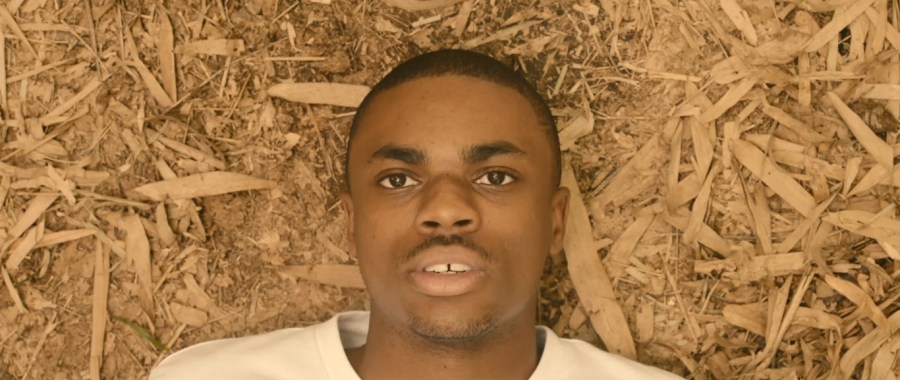
Vince Staples has been one of the most open and honest voices in hip hop since he debuted with Shyne Goldchain Vol. 1 in 2011. The past five years have seen Vince rise from Odd Future affiliate to a superstar rapper in his own right, achieving worldwide acclaim for his debut album Summertime ’06. His interviews have become so acclaimed for their humor and honesty that GQ Magazine currently has him reviewing “Every Fucking Thing“. There’s no doubt that Vince Staples is one of the biggest artists in the world right now, but that level of celebrity comes with price, and Vince uses his trademark honesty to explain just how horrific fame can be.
Vince’s latest release was Prima Donna, a seven-track EP that tells a chronologically reversed story of a rapper’s rise to fame and eventual suicide. Assisted by A$AP Rocky, Kilo Kish, DJ Dahi, James Blake, No I.D., and John Hill, it’s a claustrophobic twenty minutes of music that’s as terrifying as it is catchy. Lyrics like “Buy a million dollar home and blow my dome to paint the kitchen” show the depression that accompanies the money; fakeness, ego (portrayed by Vince’s swollen head on the cover), and the feeling of letting down his African American heritage are all dissected on Prima Donna. Depression and fear are unexpected in a public persona who’s expected to keep up a character every time they’re in the public eye:
“How you doin’, everybody, hope you had a nice day
Sometimes I feel all alone, sometimes I can’t get away
I feel my life is in danger every night when I lay
So could you do me a favour, smile for me?”
-Vince Staples, Smile
It’s a look at celebrity that strikes similar chords with Netflix’s animated hit Bojack Horseman, a show that finds a former TV star (who happens to be a talking horse, voiced by Will Arnett) struggling and failing to find all the happiness fame should have afforded him. Both Vince and Bojack are haunted by the very thing that was supposed to bring them everything they ever wanted.
Today, Vince dropped a short film to accompany his album. The ten minute video, directed by Nabil (who documented Kanye’s 2008 “Glow In The Dark” tour, and directed videos for Frank Ocean’s Channel Orange album), shows Vince leaving a music video shoot and getting into a strange cab that takes him to the “Prima Donna” hotel. Along the way, Vince is accosted by symbols of his African heritage and hosts of adoring fans, determined not to let him have a moment of peace. He shares a floor with late artists Kurt Cobain, Jimi Hendrix, and Tupac, and the constant stress and horror leads him to follow them down a similar path. One of the scariest things about the short is that Vince isn’t portraying a different character: he’s referred to by name in the video.
Vince has always been vocal about his derision for the rap game. He doesn’t fall into the typical fame cycle that many artists do, and is incapable of writing anything that doesn’t have personal meaning to him: in a feature with Noisey, he stated “n***as who know me like, ‘Vince, you don’t have fun’, like nah, I don’t got time for that. I got old real fast. Rap ain’t fun to me… shit isn’t fun. I just really gotta feel it, like it has to mean something to me… I’m not one of those people that can rap about rapping, that’s never been my shit.” California Sunday Magazine described him as one who “deplores the industry’s obsession with rivalries and is infuriated that it does so little to communicate ideas to people.”
A recent appearance on Beats 1 Radio with Zane Lowe found Vince discussing the Frank Ocean phenomenon: the insane response Frank fans had when proposed release dates came and went and the artist went four years without new music. A belief that fans were “owed” a new album became an internet obsession that saw Frank’s friends and family hounded for years, and Vince had a few words on that:
“I don’t know where we are at the point to where we can demand things. Like ‘hey, Frank Ocean, put this album out on Friday cause you never said you were going to but we need it now and we don’t like you anymore’… I don’t know when we started demanding rapid fire from those kinds of people, that’s kinda weird, when we expect rapid fire from that guy… You’re not a person when you make music. You’re a link. They just wanna click it. ‘You’re not uploaded yet, fuck you. What happened, your mom died, your car didn’t start today, you’re not in a good mood? Where’s my song?'”
Fame and celebrity is not the route to happiness: instead, it brings a whole new realm of fear and paranoia. Vince’s life has been nothing short of tumultuous, and his music has been an autobiography about the things that happen when you’re a young black gangster in the United States: songs like “Nate” and “Screen Door” give a glimpse into a life filled with the inevitability of death. This was perhaps best summer up in a statement released with Summertime ’06: “At the end of the day, we’re all dead anyway. At least where I come from.” Fame hasn’t been an escape from his demons: it’s simply brought them forth in a different way.
 Audio Plug